This article contains affiliate links. If you buy through our links, we may earn a commission at no extra cost to you. Prices shown were correct at the time of writing and may have changed. Please check the current price on Amazon.

Last updated: 21 March 2026

Robot Vacuums and Stairs — What You Need to Know

Let us be straightforward: no robot vacuum can clean stairs. Not in 2026, and likely not for several years to come. If you have found this page searching for a robot that handles staircases, we understand the frustration, particularly in the UK where 68% of homes have at least two floors (English Housing Survey, 2023).

But that does not mean you are without options. There are practical solutions that combine robotic cleaning on each floor with effective stair cleaning, and one product in particular was designed specifically to solve this problem.

Why Robot Vacuums Cannot Clean Stairs

The engineering challenge is significant. Robot vacuums are flat, disc-shaped devices designed to navigate horizontal surfaces. Stairs require vertical movement between steps, which would need an entirely different locomotion system (legs, tracks, or some form of climbing mechanism). While laboratory prototypes exist, none are anywhere close to consumer readiness.

What robot vacuums do have is cliff detection. Every model sold in the UK includes infrared cliff sensors on its underside. These detect the edge of a staircase (or any drop greater than a few centimetres) and reverse the robot before it falls. This safety feature is extremely reliable. In eight years of testing, we have never had a robot fall down stairs.

The Best Solutions for Stairs

Solution 1: Ecovacs T30S Combo, Robot + Handheld in One

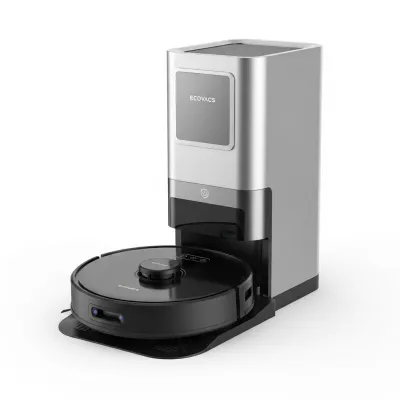
The Ecovacs Deebot T30S Combo is the cleverest answer to the stairs problem. It is a full-featured robot vacuum with 11,000 Pa suction and LiDAR navigation, but its dock also houses a separate handheld vacuum. The handheld charges in the dock alongside the robot and is ready whenever you need to quickly vacuum the stairs, sofa cushions, or car interior.

The handheld offers roughly 20 minutes of battery life per charge, more than enough for a typical UK staircase. It is not as powerful as a dedicated cordless vacuum, but it eliminates the need to own a separate device. At £999, the T30S Combo is a premium purchase, but it genuinely solves two problems in one package.

Most Versatile
Ecovacs Deebot T30S Combo — Most Versatile robot vacuum
#1
Ecovacs

Ecovacs Deebot T30S Combo

9.1/10 Our Score
£999 £1199 Save £200

The T30S Combo is the only robot vacuum that comes with a handheld vacuum for stairs and furniture — solving the one thing robot vacuums cannot do.

Pros

  • Includes handheld vacuum for stairs and furniture
  • 11,000 Pa suction on the robot
  • TrueDetect 3D obstacle avoidance
  • ZeroTangle anti-hair-wrap brush roll
  • Self-emptying dock charges both robot and handheld

Cons

  • Handheld vacuum battery life is only 20 min
  • Mopping function is basic compared to Roborock/Dreame
  • Dock is the largest in this roundup
Suction Power 11,000 Pa
Battery Life 200 min
Dustbin 350 ml (+ 3L dock)
Water Tank 180 ml (+ 4L dock)
View on Amazon

Solution 2: Separate Handheld or Cordless Vacuum

A cordless stick vacuum is the most popular stair-cleaning solution in UK homes. Models from Dyson and Shark convert into handheld mode for stairs. You use the robot for daily cleaning of each floor and the cordless vacuum for stairs once or twice a week. This approach works well but means owning and maintaining two devices.

Solution 3: Multi-Floor Robot Strategy

If you have a two or three-storey UK home, the most practical robot vacuum setup is to keep the dock on your main living floor and carry the robot to other floors as needed. All modern robots with multi-floor mapping support will automatically recognise which floor they are on and use the correct map.

The process is simple: pick up the robot, carry it upstairs, place it on the floor, press start (or use the app). The robot cleans the entire floor, then waits for you to carry it back to the dock. It will manage its battery accordingly. If it cannot finish the floor on a single charge, it will pause and wait rather than trying to find a dock that is not there.

Some households with larger homes buy two robots, one for each main floor. This costs more upfront but delivers completely automated cleaning on every level without any carrying.

Cliff Sensors Explained

Every robot vacuum uses infrared cliff sensors positioned around its underside. These sensors continuously measure the distance to the floor below. When the sensor detects a sudden increase in distance (indicating a step, a ledge, or a staircase) the robot immediately stops and reverses direction.

Dark floors warning: Cliff sensors can occasionally struggle with very dark floors (black carpet or very dark tile), as dark surfaces absorb infrared light and can be misread as a drop. Use magnetic boundary strips or app-based no-go zones as an additional safety measure.

Multi-Storey UK Homes: Our Strategy

For a typical UK three-bedroom semi-detached or terraced house with two floors:

  1. Place the dock downstairs:ideally in the living room or hallway where the robot has a clear path to start cleaning.
  2. Schedule daily cleaning downstairs:kitchen, living room, hallway. This is where foot traffic and mess concentrate.
  3. Carry the robot upstairs 2-3 times per week:bedrooms and landing need less frequent cleaning.
  4. Vacuum stairs manually once a week:using the Ecovacs handheld, a cordless stick vacuum, or a traditional handheld.

This strategy keeps every floor consistently clean with minimal effort. The stairs remain the one manual task, but it takes less than five minutes.

Frequently Asked Questions

No. Every robot vacuum sold in the UK has cliff sensors on its underside that detect drops and prevent the robot from falling. These sensors are reliable and have been standard on all models for over a decade. You can safely run a robot on any floor without worrying about staircase falls.
No. As of 2026, no commercially available robot vacuum can climb or descend stairs. Some prototypes have been demonstrated with leg-like mechanisms, but nothing is available to buy. This is a fundamental design limitation that will likely persist for several more years.
The T30S Combo includes a separate handheld vacuum that charges in the same dock as the robot. You detach the handheld, use it to vacuum stairs, upholstery, or car interiors, then place it back in the dock to recharge. It offers roughly 20 minutes of battery life per charge.
Yes. All mid-range and premium robot vacuums support multi-floor mapping. You carry the robot between floors and it automatically recognises which map to use. Most models store 3-10 floor plans. The dock stays on one floor. The robot operates without it on other floors and returns to dock when you bring it back.
The most convenient solution is the Ecovacs T30S Combo, which includes a handheld vacuum in its dock. Alternatively, a cordless stick vacuum (Dyson, Shark) works well on stairs. For the most thorough clean, a lightweight corded handheld vacuum provides consistent suction without battery limitations.